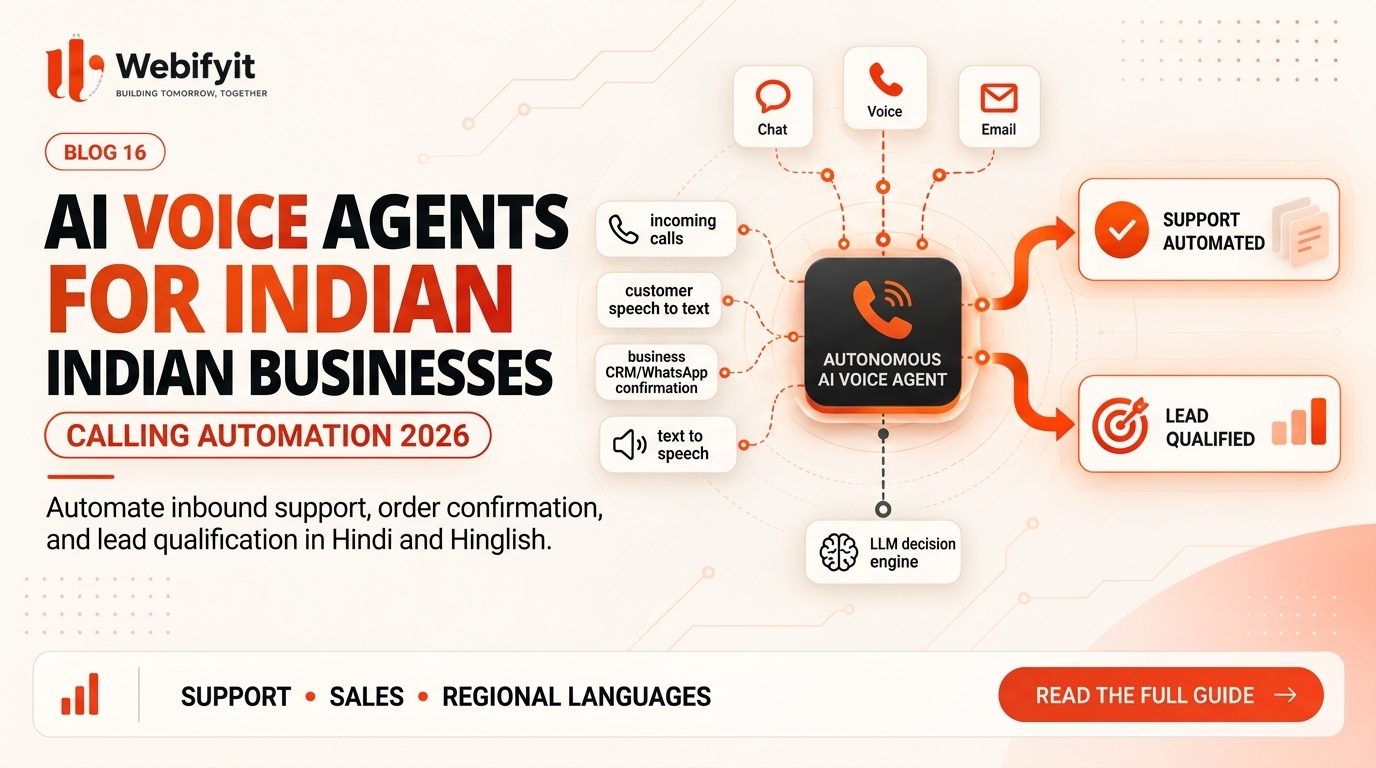
<h1>AI Voice Agents for Indian Businesses: How to Automate Calling, Support, and Lead Qualification in 2026</h1> <p>For more than two decades, the experience of calling an Indian business has been notoriously frustrating. Every consumer knows the drill: dial a number, listen to a robotic recording reciting, <em>'Press 1 for Sales, Press 2 for Billing, Press 9 to speak with our representative,'</em> wait on hold for nine minutes listening to distorted elevator music, and finally get disconnected.</p> <p>In <strong>2026</strong>, that antiquated approach is actively driving paying customers away. Today's digital consumers demand instant resolution. If a prospect calls your company and encounters an IVR maze or an unanswered ringing tone after business hours, they hang up and dial your competitor within thirty seconds.</p> <p>At the same time, maintaining an in-house call center or outsourcing to third-party BPOs has become prohibitively expensive. Between high staff attrition, constant training cycles, shift allowances, and telecom infrastructure costs, handling customer phone calls eats away at operating margins.</p> <p>Enter <strong>Autonomous AI Voice Agents</strong>—the most pivotal breakthrough in Indian enterprise communication since the rollout of 5G. These are not rigid rule-based bots; they are fluent, context-aware digital conversationalists capable of understanding accents, handling interruptions, updating your database, and resolving customer inquiries over standard phone lines in real time.</p> <hr /> <h2>Why Traditional Phone Systems and IVRs Fail Indian Buyers</h2> <p>The failure of legacy Interactive Voice Response (IVR) systems in India is rooted in how Indian consumers naturally speak and communicate:</p> <ul> <li><strong>Linguistic Fluidity (Code-Switching):</strong> Indian callers rarely speak in textbook Oxford English or pure Hindi. They mix languages effortlessly: <em>'Sir mera order deliver nahi hua, can you check status please?'</em> Traditional voice recognition software stumbles over code-switched phrases, leading to immediate failure.</li> <li><strong>Intolerance for Linear Menus:</strong> Mobile callers do not have the patience to sit through 45 seconds of menu options. Over <strong>65% of callers hang up</strong> before reaching a human operator when forced through more than two menu levels.</li> <li><strong>Lack of Real Actionability:</strong> Traditional telephony systems are completely disconnected from operational business data. An IVR cannot query a live warehouse database, cannot issue a refund, and cannot schedule a technician visit on a calendar.</li> <li><strong>Severe Capacity Constraints:</strong> When a product launch, festive sale, or service outage triggers a surge in call volume, traditional phone trees queue callers indefinitely. Frustrated customers take to social media to voice their complaints, damaging brand reputation.</li> </ul> <hr /> <h2>The Technical Architecture of a 2026 AI Voice Agent</h2> <p>Building an AI voice agent that sounds like a natural human requires orchestrating three discrete technologies with ultra-low latency:</p> <table border="1" cellpadding="8" cellspacing="0" style="width: 100%; border-collapse: collapse; text-align: left; margin: 24px 0;"> <thead> <tr style="background-color: #f1f5f9;"> <th>Pipeline Component</th> <th>Legacy Approach (Pre-2024)</th> <th>Modern 2026 Voice AI Stack</th> <th>Latency Impact</th> </tr> </thead> <tbody> <tr> <td><strong>1. Speech-to-Text (STT)</strong></td> <td>Generic cloud transcription models tuned for US English</td> <td>Acoustically tuned Whisper & Deepgram models trained on Indian accents, dialects, and ambient background noise</td> <td>~120 ms</td> </tr> <tr> <td><strong>2. Reasoning Engine (LLM)</strong></td> <td>Rigid keyword-matching decision trees</td> <td>Streaming reasoning LLMs with strict system prompts, guardrails, and deterministic tool-calling bindings</td> <td>~180 ms</td> </tr> <tr> <td><strong>3. Text-to-Speech (TTS)</strong></td> <td>Monotone, robotic concatenative voices</td> <td>Ultra-expressive neural voice synthesis (Cartesia / ElevenLabs Turbo) with natural pauses, breaths, and regional pitch modulations</td> <td>~90 ms</td> </tr> <tr> <td><strong>Total End-to-End Latency</strong></td> <td><strong>2,500 ms – 4,000 ms</strong> (Unusable, robotic lag)</td> <td><strong>&lt; 400 ms</strong> (Feels completely conversational and human)</td> <td><strong>Instantaneous</strong></td> </tr> </tbody> </table> <p>Crucially, modern systems support <strong>Full-Duplex Interruption Handling</strong>. When the human caller interrupts the agent mid-sentence, the system immediately cuts audio output, recalculates context, and replies politely—just like a skilled human representative.</p> <hr /> <h2>Four Transformational Use Cases for Indian Companies</h2> <p>Forward-thinking Indian businesses across sectors are already deploying custom voice agents to capture revenue and automate repetitive operations:</p> <h3>1. E-Commerce & D2C: Automated Cash-on-Delivery (COD) & NDR Verification</h3> <p>Cash-on-Delivery orders remain a dominant payment method in India, but Return-to-Origin (RTO) rates frequently reach 30% to 40%, wiping out profit margins. An AI voice agent automatically calls buyers within five minutes of placing a COD order: confirms the full address, checks PIN-code deliverability, and confirms buyer intent. If the customer requests delivery on a specific date, the agent updates the logistics portal automatically. Result: RTO reduced by up to <strong>55%</strong>.</p> <h3>2. Real Estate & Education: Instant High-Intent Lead Qualification</h3> <p>When a prospective buyer clicks an ad for a residential flat or an executive MBA course, speed-to-lead determines conversion. If a human agent takes four hours to call back, the lead is cold. An AI voice agent initiates a courteous phone call within <strong>45 seconds</strong> of form submission, qualifies the buyer's budget and preferred location, answers technical questions, and books a site visit directly on the sales executive's calendar.</p> <h3>3. Healthcare, Diagnostic Labs & Clinics</h3> <p>Patients calling to book health checkups or MRI scans no longer wait for receptionist desks. The voice agent verifies insurance coverage, suggests available time slots with specific specialists, books appointments in the hospital management software, and sends an automated WhatsApp confirmation with Google Maps directions.</p> <h3>4. Financial Services & FinTech: Outbound Collection Reminders & EMI Notices</h3> <p>Delicate debt recovery and payment reminders require respectful, consistent communication. Voice agents conduct thousands of simultaneous personalized calls in the borrower's native language, explaining outstanding balances, answering payment questions, and instantly texting a direct UPI payment link while remaining on the call.</p> <hr /> <h2>Cost Economics: Human BPO vs. Autonomous AI Voice Agents</h2> <p>Let us look at the actual operational math for an Indian business handling <strong>20,000 inbound/outbound calls per month</strong>:</p> <ul> <li><strong>Traditional Outsourced BPO Model:</strong> <ul> <li>Requires a team of 8 full-time telecallers + 1 team lead.</li> <li>Average cost per telecaller (salary, workstation, management, telecom trunk): ₹25,000 – ₹30,000/month.</li> <li>Monthly expenditure: <strong>₹2,25,000 – ₹2,70,000</strong>.</li> <li>Cost per call: <strong>₹11.25 – ₹13.50</strong> (excluding high attrition recruitment expenses).</li> <li>Operating hours: Capped strictly at 10 AM to 7 PM (zero weekend/night coverage).</li> </ul> </li> <li><strong>Webifyit Custom AI Voice Agent Architecture:</strong> <ul> <li>Runs 24 hours a day, 7 days a week, 365 days a year without overtime or sick leaves.</li> <li>Cloud telephony trunking (Exotel/Twilio) + GPU inference + streaming API costs: ~₹1.60 per average 2-minute call.</li> <li>Flat maintenance and monitoring fee: ~₹20,000/month.</li> <li>Total monthly expenditure: <strong>~₹52,000</strong>.</li> <li>Cost per call: <strong>₹2.60</strong>.</li> </ul> </li> </ul> <p>That delivers an immediate <strong>75% to 80% operational cost reduction</strong>, while eliminating missed customer calls forever.</p> <hr /> <h2>Regulatory & Compliance Essentials: TRAI & India's DPDP Act 2023</h2> <p>Deploying voice automation in India requires strict adherence to telecommunication and data privacy regulations:</p> <ul> <li><strong>TRAI 140 & 160 Numbering Series:</strong> All commercial and transactional outbound calls must originate from verified business PRI trunks adhering to Department of Telecommunications (DoT) mandates to prevent carrier spam flagging.</li> <li><strong>Explicit Consent & DND Scraping:</strong> Promotional calling lists must be scrubbed against the National Do Not Disturb (NDND) registry via automated API before dialing.</li> <li><strong>Indian Data Residency (DPDP Act):</strong> Call audio recordings and customer transcripts must be stored in encrypted Indian cloud data centers (e.g., AWS Mumbai / Azure Central India) with role-based access controls and automatic redaction of sensitive payment details.</li> </ul> <hr /> <h2>Frequently Asked Questions</h2> <h3>Can the AI Voice Agent speak in regional Indian languages?</h3> <p>Yes. The system natively understands and converses in Hindi, Hinglish, Marathi, Tamil, Telugu, Bengali, and Indian-accented English with high contextual accuracy.</p> <h3>What happens if a customer asks a complex question the AI cannot resolve?</h3> <p>The system features an automated <strong>Warm Transfer Protocol</strong>. The AI politely puts the customer on hold, dials your senior specialist, whispers a 5-second audio briefing of the caller's context to the human agent, and patches the caller through seamlessly.</p> <h3>How does the voice agent update our internal software?</h3> <p>Through secure REST APIs and webhooks. Whether your company uses Salesforce, HubSpot, Zoho CRM, Shopify, or a custom internal database, the voice agent reads and writes records during the live call.</p> <h3>Can the voice agent send documents or payment links during the call?</h3> <p>Yes. While speaking to the caller, the agent can trigger official WhatsApp messages or SMS containing PDF brochures, invoice copies, or dynamic UPI payment links.</p> <hr /> <h2>Build Your Custom Voice AI System with Webifyit</h2> <p>At <strong>Webifyit</strong>, we engineer tailored web applications, autonomous agentic workflows, and high-performance Voice AI systems designed specifically for Indian founders, scaling startups, and established enterprises.</p> <p>Ready to automate your inbound call center, accelerate lead conversions, and eliminate hold times?</p> <p><strong><a href="https://webifyit.in/contact">Schedule an Architectural Consultation with Atharv at webifyit.in/contact</a></strong> to review your telephony workflows and receive a production deployment blueprint.</p> <hr /> <p><em>Published by Atharv, Founder at Webifyit | <a href="https://webifyit.in">webifyit.in</a></em></p>