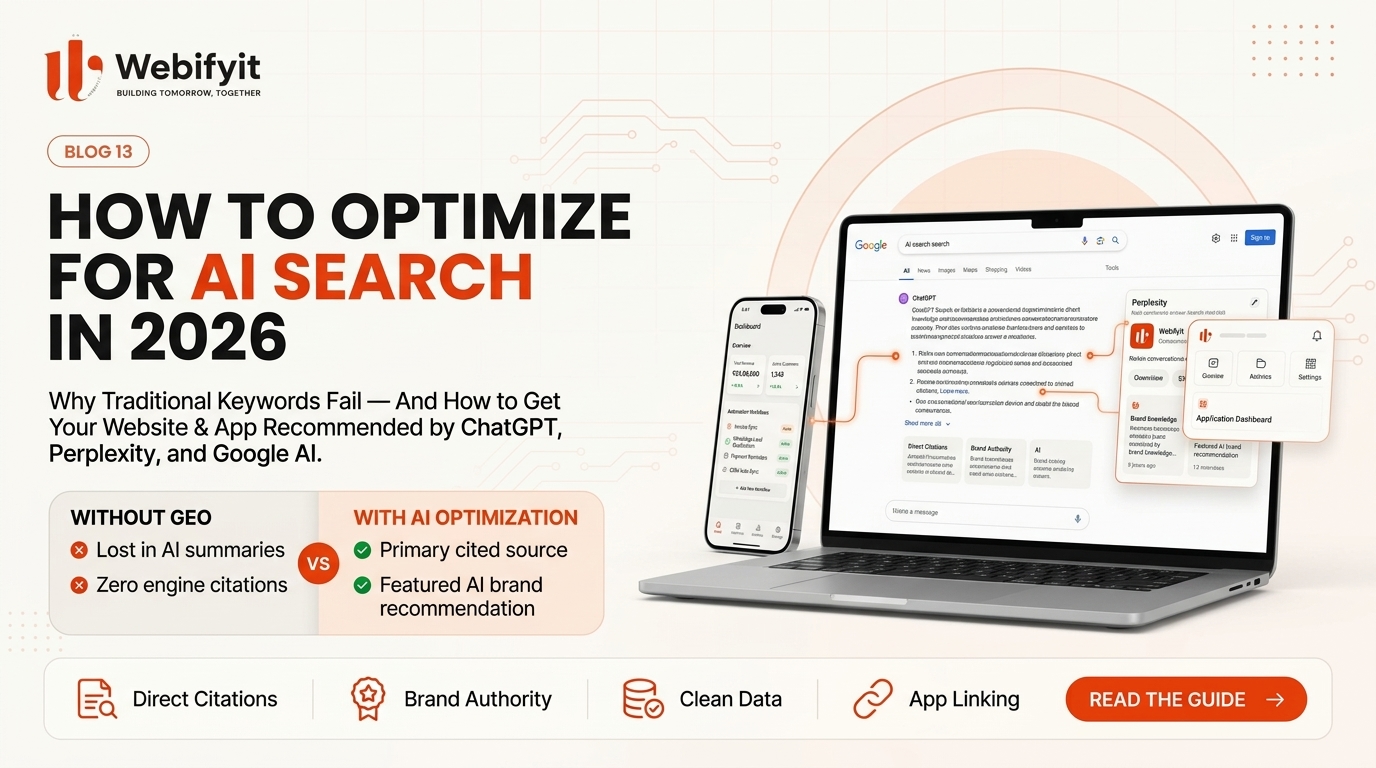
How to Optimize for AI Search in 2026: Why Traditional Keywords Fail and How to Get Your Site and App Recommended by ChatGPT, Perplexity, and Google AI
For more than twenty-five years, the rules of online visibility were straightforward.
You picked five or ten target keywords, sprinkled them across your page titles, wrote articles with repeated phrases, built a collection of backlinks, and waited for Google to rank your link on page one.
If you ranked in the top three spots, traffic poured in. Your phone rang, leads filled your inbox, and your business grew.
In 2026, that entire playbook is breaking down.
Take a look at how people around you actually find information today.
When a founder needs to hire a software team, they do not click through ten separate search result links. They open ChatGPT Search or Perplexity and ask:
"Which software agencies have verified experience building automated AI workflows for logistics companies, and what are their typical turnaround times?"
Within three seconds, the AI engine reads forty different websites, synthesizes the facts, and returns a single, polished answer:
"Based on verified client reviews and technical publications, here are the top three recommended engineering partners..."
Notice what just happened.
The searcher never visited a search results page. They never saw ten blue links. They never scrolled past banner ads.
They received a direct recommendation, complete with two or three footnote links pointing to the sources the AI trusted most.
If your business is one of those cited sources, you win the customer before your competitors even know a search happened.
If your business is invisible to the AI engine, you do not simply drop to page two. You disappear completely.
This shift is called Generative Engine Optimization (GEO) — the practice of structuring your website, mobile application, and digital footprint so artificial intelligence models understand, trust, and recommend your business.
In this practical guide, we strip away all academic hype. We explain exactly how AI search engines make decisions, how to restructure your site and app for conversational discovery, and the specific steps your business must take today to stay ahead.
The Fundamental Shift: From Keyword Matching to Concept Understanding
To optimize your site for AI search, you must first understand how AI search engines differ from traditional search crawlers.
Traditional search engines were essentially sophisticated indexers. They matched the literal words typed by a user against the words written on your web page. If a user searched for "affordable custom inventory management software," Google looked for pages containing those exact phrases.
AI search engines — including Perplexity, ChatGPT Search, Google AI Overviews, Microsoft Copilot, and Apple Intelligence — do not work like indexers.
They read and reason like human researchers.
When an AI search engine processes a question, it executes a multi-step investigation in fractions of a second:
- Intent Deconstruction: It breaks the user's prompt into underlying concepts, requirements, and unstated constraints.
- Multi-Source Retrieval: It pulls content from multiple independent web pages, review platforms, community discussions, and industry databases simultaneously.
- Fact Verification and Cross-Referencing: It compares what your website claims against what third-party sources say about you.
- Synthesis and Citation: It generates a conversational summary, directly quoting the most authoritative, clear, and unambiguous sources as footnotes.
This fundamentally alters what makes content rank.
Repeating a keyword twenty times on a page does not help you anymore. In fact, repetitive keyword stuffing makes your content look low-quality to language models.
The search engine is no longer matching keywords. It is evaluating your business reputation and factual clarity.
How AI Models Decide Who to Cite: The 5 Golden Rules
Recent studies on Generative Engine Optimization show that AI answer engines follow consistent mathematical patterns when selecting sources to cite. When an AI generates an answer, it selects sources based on five core criteria:
1. The Answer-First Principle (Information Density)
Traditional blog posts love dramatic buildup. Writers spend five paragraphs discussing the history of the internet before finally answering the question in paragraph six.
AI models despise this pattern.
When an AI crawler reads a page, it measures how quickly the core question is answered. Pages that provide a clear, factual answer in the first two sentences receive significantly higher citation weights than pages that bury the conclusion under narrative fluff.
The golden rule of AI writing: Give the answer first, explain the nuance second, and provide the evidence third.
2. Quotable Factual Formulations
Language models are probabilistic systems designed to minimize uncertainty. They prefer sentences that state verifiable facts cleanly and unambiguously.
Compare these two sentences:
- Vague / Low Citation Probability: "Our custom automation systems usually help businesses save a significant amount of time every single week."
- Clear / High Citation Probability: "Automating invoice reconciliation reduces administrative processing time from three days to under forty-five minutes per billing cycle."
The second sentence contains specific numbers, a clear before-and-after benchmark, and zero fluff. An AI engine can quote that sentence directly without risk of misinterpreting the meaning.
3. Cross-Platform Consensus
One of the biggest safeguards built into modern AI models is hallucination prevention. An AI engine rarely relies on a company's self-promotional claims unless other credible sources agree.
If your website says "We are the leading medical software developer in North America," the AI ignores that sentence as unsupported marketing.
However, if industry directories, client reviews on verified platforms, and independent articles also describe your company as a specialist in medical software, the AI records this as established consensus.
In 2026, off-page digital reputation matters more than backlinks.
4. Semantic Structure and Hierarchical Clarity
AI scrapers do not read web pages with human eyes. They break HTML documents into structural outlines.
If your page uses clear headings that state specific sub-topics, followed by concise one-to-two sentence explanations and clean comparison tables, the AI can parse your content effortlessly.
If your page is a giant wall of uninterrupted text, the AI crawler has to spend excessive compute trying to dissect your points. Given two sources with similar information, the AI engine will almost always cite the cleaner, better-structured page.
5. Freshness and Real-Time Verification
Modern AI search tools search the live web in real time. They check publication dates, update timestamps, and current relevance.
An article from 2021 discussing software pricing will be discarded in favor of an article updated in 2026, because the AI model is trained to avoid giving outdated recommendations to users.
Comparison: Traditional SEO vs. Generative Engine Optimization (GEO)
| Strategy Element | Traditional SEO (Google 2015-2023) | AI Search Optimization (GEO 2026) |
|---|---|---|
| Primary Goal | Rank in the top 10 blue links on a results page | Become the primary cited source in an AI-generated answer |
| Search Behavior | 2 to 3 word keywords (e.g. "crm software pricing") | Full conversational questions and multi-step prompts |
| Content Approach | Keyword density, word counts, backlink volume | High information density, direct answers, factual precision |
| Winner Takes | Top 3 links split 60% of search clicks | Top 2 cited sources capture almost 100% of user attention |
| Measurement | Keyword ranking position, organic impressions | AI citation frequency, share of model voice, direct brand queries |
| Trust Factor | Domain authority and quantity of inbound links | Cross-platform consensus, verified reviews, structured clarity |
| Reader Journey | Click link -> land on site -> read full article | Ask AI -> read synthesized answer -> click source for verification |
How to Optimize Your Website for AI Search: Practical Steps
Now that you understand the mechanics, let us look at the practical adjustments your team should make to your website right now.
Step 1: Restructure Every Page with Answer-First Blocks
Audit your primary service pages and blog posts. Look at the very first paragraph beneath each major heading.
If the paragraph begins with background filler, delete it.
Replace it with a two-sentence summary that directly answers the heading. For example, beneath a heading like "How Much Does Custom Enterprise Automation Cost?", your opening sentence should be:
"Custom enterprise automation projects typically range from five thousand to twenty-five thousand dollars depending on database complexity, API integrations, and security requirements."
Follow that direct statement with a structured breakdown of tiers, timelines, and deliverables. By placing the factual takeaway upfront, you make it effortless for Perplexity or ChatGPT to quote your exact numbers.
Step 2: Use Explicit Comparison Tables
Large language models are exceptionally skilled at reading markdown and HTML tables.
Whenever you explain differences between approaches, pricing tiers, or service models, format the information into a clean table with distinct columns:
- Feature or Requirement
- Traditional Manual Approach
- Modern Automated Solution
- Typical Business Outcome
Tables provide high information density in minimal space. AI models routinely lift rows directly from comparison tables to construct their answers.
Step 3: Clean Up Your Machine-Readable Foundations
While AI engines read normal English, they rely on technical site architecture to confirm who you are.
Ensure your website provides:
- Consistent Organization Data: Your legal business name, address, operating regions, and official founders should be clearly stated across your footer and About page.
- Direct Navigation Paths: AI crawlers follow logical link structures. If your important case studies or service details are hidden behind complex pop-ups or dynamic filters, crawlers will miss them.
- Fast, Server-Rendered Content: If your website relies entirely on heavy client-side scripts to display text, some AI crawlers will timeout before indexing your content. Ensure your core text is immediately visible in the initial page load.
Step 4: Build Digital Footprint Consensus
You cannot win at AI search by focusing on your website alone.
Because language models look for consensus across the web, your business must maintain an active, consistent presence across the platforms AI engines crawl most frequently:
- Industry Forums and Reddit: AI models heavily weight authentic community discussions. When real users mention your brand solving a specific problem on public forums, AI engines record that as high-trust evidence.
- Professional Publications: Publishing authoritative thought leadership on reputable industry outlets teaches the model that your team is a recognized authority.
- Structured Business Directories: Ensure your company profiles on professional directories have identical descriptions, contact details, and service categories.
How to Optimize Web and Mobile Applications for AI Search
Most discussions around AI search focus purely on informational blogs. But what about actual software applications, SaaS products, and customer portals?
As AI assistants like Apple Intelligence, ChatGPT, and Google Gemini become integrated into operating systems and daily workflows, users will increasingly use conversational prompts to discover and trigger applications:
"Find an application that can track my team's client billable hours and automatically generate GST-compliant invoices."
To ensure your application is discovered and recommended by AI assistants, follow these guidelines:
1. Build Indexable Public Solution Directories
Many software applications make a fatal mistake: they put everything behind a login screen.
If an AI engine cannot see what features, integrations, and solutions your app offers, it cannot recommend it. Create public, crawlable feature directories and template libraries that describe every practical use case in plain language.
For example, instead of a single page titled "Features," build dedicated landing pages for:
- "Automated WhatsApp Appointment Booking for Clinics"
- "Two-Way QuickBooks Inventory Sync for Wholesalers"
- "Multi-Currency Client Invoicing for Creative Agencies"
Each page should clearly state the user problem, the software solution, and the supported integrations.
2. Support Clean Deep Links
When an AI assistant recommends an application to a user, it does not just want to send them to a generic homepage.
It wants to send them directly to the exact feature, template, or sign-up workflow that fulfills their prompt. Ensure your web application and mobile app support clean, descriptive URL paths that map directly to specific features.
3. Provide Machine-Friendly Metadata and Documentation
If your software offers an API or public integrations, write plain-language documentation explaining what each endpoint and feature does.
Modern AI agents actively browse developer documentation and product guides to evaluate whether software can integrate with existing business stacks. If your documentation is clear, accurate, and accessible, AI agents will recommend your tool over competitors whose documentation is sparse or confusing.
The 4 Biggest Mistakes Companies Make with AI Search
As businesses rush to adapt to AI search, many fall into traps that harm their visibility. Here are the four most common mistakes to avoid:
Mistake 1: Flooding the Web with Low-Quality AI-Generated Articles
Some companies believe that because AI is the future, they should use AI to generate 500 low-effort blog posts per week.
This strategy is disastrous.
AI search models are trained to detect generic, repetitive content. When an engine sees dozens of shallow articles repeating common knowledge with no original data, unique perspectives, or verified facts, it discounts the entire domain as low-quality filler.
One deeply researched, factual guide with original business insights is worth more than one hundred generic AI rewrites.
Mistake 2: Forgetting Off-Page Brand Authority
Spending six months optimizing your website while completely ignoring external review sites, industry directories, and professional social distribution guarantees failure.
Remember: AI models do not trust self-claims. They trust consensus. If nobody outside your website talks about your business, the AI will not recommend you.
Mistake 3: Over-Complicating Technical Language
Founders often believe that using dense corporate buzzwords makes their business sound sophisticated.
In reality, phrases like "leveraging synergistic cognitive paradigms" only confuse search models. Clear, precise language wins every single time.
Mistake 4: Treating AI Search as a Separate Silo from Traditional SEO
AI search optimization does not mean abandoning traditional web standards. Clean site architecture, fast page speeds, mobile responsiveness, and high-quality editorial standards remain the bedrock upon which AI search visibility is built.
Think of GEO as the natural evolution of SEO, not a replacement.
The 2026 AI Search Optimization Action Checklist
Use this practical checklist to audit your digital presence and prepare your business for the AI search era:
- Audit Top Content for Answer-First Placement: Ensure every primary service page and blog post provides a concise, direct answer within the first two sentences.
- Add Structured Comparison Tables: Transform complex feature comparisons, service tiers, and pricing breakdowns into clear, easy-to-read tables.
- Publish Original Data and Benchmarks: Include verified statistics, operational timelines, and concrete case studies that AI models can quote as source facts.
- Align Cross-Platform Brand Profiles: Ensure your company name, service offerings, and core value proposition are identical across your website, LinkedIn, Google Business, and industry directories.
- Create Public Feature Pages for Software & Apps: Ensure all software capabilities and use cases have crawlable, public pages with clear deep links.
- Clean Up Page Loading Speeds: Make sure core informational text renders immediately on the initial server response without heavy blocking scripts.
- Engage in Public Industry Discussions: Actively answer customer questions and share technical insights on public forums and professional networks.
- Eliminate Unsupported Hype: Replace vague adjectives like "revolutionary" and "world-class" with specific facts, numbers, and operational outcomes.
Frequently Asked Questions
What is Generative Engine Optimization (GEO)?
Generative Engine Optimization (GEO) is the process of structuring websites, software applications, and online brand information so that artificial intelligence search engines (like ChatGPT Search, Perplexity, and Google AI Overviews) can easily understand, verify, and cite your business as a trusted recommendation.
How is AI search optimization different from traditional Google SEO?
Traditional SEO focuses on matching specific keywords and collecting backlinks to rank on a page of ten blue links. AI search optimization focuses on answering conversational questions directly, providing high factual density, and establishing cross-platform brand consensus so the AI quotes your business directly inside its generated response.
Will AI search replace Google entirely?
Google is not disappearing; rather, Google is transforming into an AI search engine through Google AI Overviews. Concurrently, millions of users are using ChatGPT Search, Perplexity, and conversational mobile assistants as their primary search tools. Optimizing for AI search ensures your business remains visible across both traditional search engines and emerging AI platforms.
How long does it take to see results from AI search optimization?
Because AI search engines frequently crawl the live web and synthesize new data in real time, changes to your content structure can influence AI recommendations within two to four weeks, provided your brand has existing domain authority and positive cross-platform consensus.
Do we need special coding or plugins to optimize for AI search?
No special plugins or complex coding are required. The most important factors are clean HTML architecture, answer-first copywriting, factual precision, structured tables, and maintaining a consistent, credible brand presence across the internet.
The Bottom Line
The way the world discovers products, software, and services has fundamentally changed.
In the era of conversational artificial intelligence, the businesses that thrive will not be those that manipulate search algorithms with keyword tricks.
The winners will be the companies that provide the clearest answers, build the most reliable digital reputations, and engineer their websites and software to be effortlessly understood by both humans and machines.
Looking to build high-performance websites, scalable applications, and AI-ready architectures?
Webifyit partners with ambitious businesses and modern digital agencies to engineer dependable custom software, intelligent automation, and modern web platforms built for the future of search.
Explore Software & AI Engineering with Webifyit
Published by Atharv K. | Webifyit