
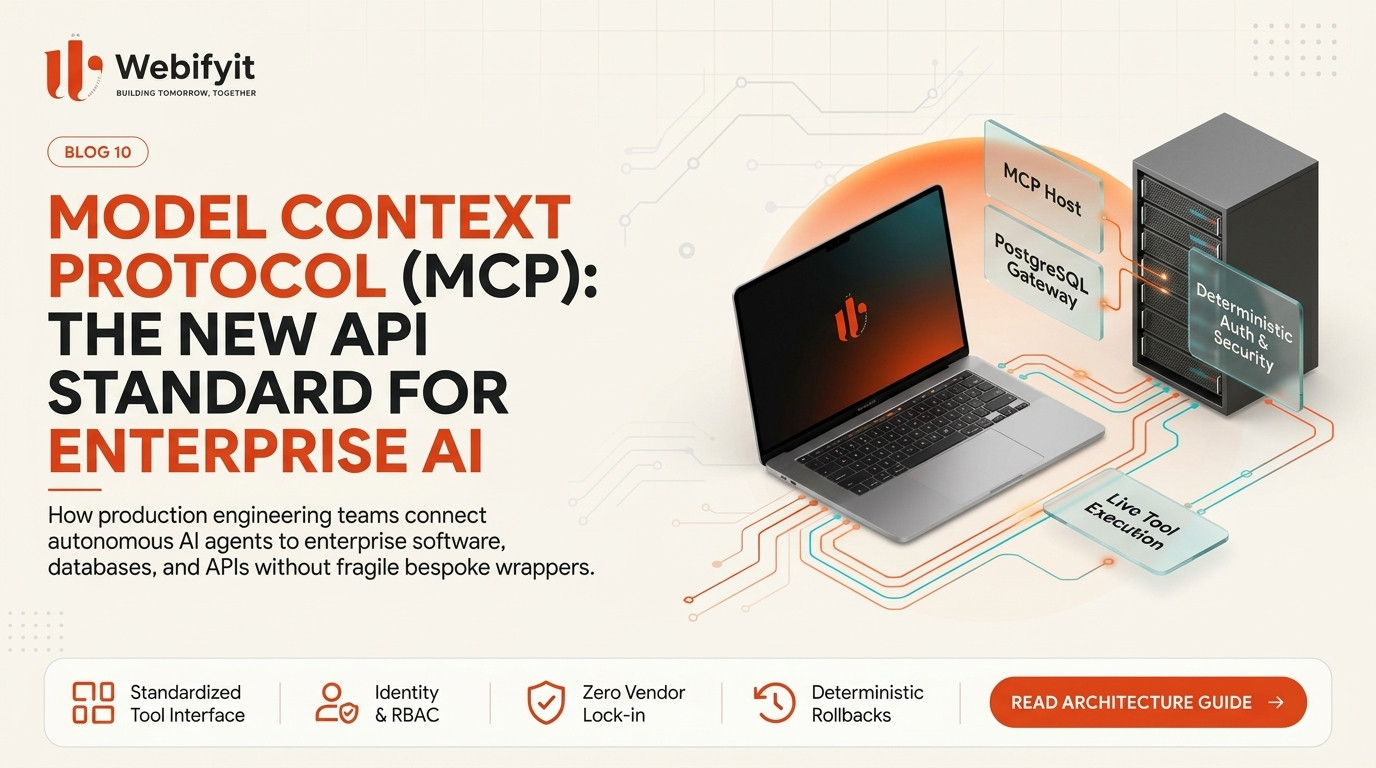
Model Context Protocol (MCP): The New API Standard for Enterprise AI
An enterprise engineering team sets out to build an internal AI assistant to query customer records, summarize invoice history, and generate support tickets.
During week one, the team writes custom Python scripts connecting an LLM to their PostgreSQL database and Salesforce API. The demo impresses leadership.
By month three, the team attempts to add access to Google Drive, Jira, GitHub, and their internal billing system. Suddenly, the architecture collapses under its own weight.
Every time an upstream API changes an authentication header or returns a modified payload structure, the custom integration breaks. The AI hallucinated parameters when calling external endpoints. Engineering hours shifted entirely from shipping product features to maintaining bespoke integration glue.
This pattern has played out in hundreds of enterprise engineering departments over the past two years. The industry spent billions optimizing foundational language models, yet connecting those models to real business data remained an exercise in fragile, point-to-point scripting.
Model Context Protocol (MCP) emerged to resolve this bottleneck.
The M x N Integration Problem in Enterprise AI
Before standardized protocols, connecting systems followed an M-by-N pattern.
If an organization deployed three different AI assistants (for customer support, internal engineering, and financial analysis) across twelve internal systems (databases, CRM tools, document stores, and ticket queues), developers had to build thirty-six distinct point-to-point connectors.
Each connector required:
- Custom prompt formatting describing available functions
- Bespoke authentication token management
- Custom data serialization and response truncation
- Error-handling logic to catch malformed tool calls
- Individual logging and audit trailing
When a team upgraded from one model version to another, prompts that previously triggered accurate tool calls began failing. Upgrading software became an operational risk.
Model Context Protocol replaces point-to-point spaghetti with a universal client-server specification. Rather than building custom bridges between every model and every system, companies expose their tools and data sources as MCP servers.
Any compliant AI client can now connect to any MCP server out of the box, reducing thirty-six individual integration efforts into fifteen standardized endpoints.
How Model Context Protocol Functions in Production
MCP uses an open architecture built on lightweight JSON-RPC communication.
The system divides responsibility into three core participants:
1. The MCP Host
The host is the application coordinating the user experience and running the AI model. Examples include enterprise desktop environments, automated workflow orchestration engines, or custom agent runtimes. The host maintains the conversation state and decides when external tools are needed.
2. The MCP Client
The client operates inside the host application. It establishes secure connections to external MCP servers, requests tool schemas, and formats user requests into standardized protocol messages.
3. The MCP Server
The server is a standalone process exposing specific capabilities to the AI client. A company might run an MCP server for their inventory database, another for their customer billing system, and a third for document storage.
Each MCP server exposes three standard primitives:
- Resources: Passive data feeds that the AI can inspect for context (such as customer profiles, database table schemas, or log streams).
- Prompts: Pre-engineered templates and guidance published directly by the server, ensuring models request data using optimal instructions.
- Tools: Executable actions the model can trigger with human or automated approval (such as generating an invoice, updating a ticket status, or dispatching an email notification).
Bespoke Integrations vs. Model Context Protocol
| Technical Attribute | Legacy Custom AI Wrappers | Model Context Protocol Architecture |
|---|---|---|
| Architecture Pattern | Point-to-point custom code | Standardized client-server protocol |
| Model Portability | High lock-in; prompts tied to specific LLMs | Zero lock-in; swap underlying models freely |
| Schema Discovery | Static prompt injection consuming context tokens | Dynamic runtime tool and resource discovery |
| Permission Model | All-or-nothing API key exposure | Granular capability-based access controls |
| Maintenance Cost | High; breaks whenever third-party APIs update | Low; server exposes stable contract to all clients |
| Transport Layer | Hardcoded HTTP requests and ad-hoc scripts | Standardized JSON-RPC over STDIO or Server-Sent Events |
Enterprise Security: Solving the Agent Authorization Dilemma
The single largest barrier to enterprise AI adoption is security.
When an AI model connects to business data using a raw API key, it typically inherits excessive privileges. An AI agent given admin credentials to query customer emails could theoretically delete the entire customer database if prompted maliciously or confused by an ambiguous instruction.
MCP addresses this through explicit separation between inspection and execution.
1. Read-Only Resource Boundaries
MCP servers can expose sensitive corporate data as passive resources without granting write access. An AI assistant can review contract terms, read financial summaries, and inspect order histories without possessing endpoints capable of altering records.
2. Granular Human-in-the-Loop Triggers
Every executable tool exposed by an MCP server includes structured metadata declaring its potential impact. Engineering teams configure their MCP hosts to require explicit human operator approval whenever a tool action modifies persistent state or exceeds financial thresholds.
For example, an AI agent analyzing late accounts can draft payment reminder notifications autonomously. However, triggering the actual payment collection charge requires a human finance manager to click an approval confirmation in the host interface.
3. Complete Audit Trails
Because all communication flows through standardized JSON-RPC envelopes, enterprise security teams can log every query, context payload, and tool invocation centrally. Compliance officers know exactly what data the model inspected and what actions it attempted at every second of an interaction.
Four High-Impact Enterprise MCP Implementation Scenarios
Forward-thinking businesses are deploying MCP across four primary operational areas:
1. Internal Engineering Productivity
Engineering teams connect their development assistants to MCP servers exposing Git repositories, CI/CD build logs, and issue trackers. Developers ask natural questions about deployment failures and receive answers containing real-time build telemetry without manually digging through server logs.
2. Operational Customer Support
Support agents query unified MCP servers spanning Zendesk, Stripe, and internal inventory databases. The AI synthesizes customer subscription tiers, shipping status, and prior tickets into a concise summary card in seconds, cutting ticket resolution times from twelve minutes to two minutes.
3. Financial Document Analysis
Finance teams deploy local MCP servers connecting to secure document directories and accounting software. The model parses quarterly vendor invoices, flags duplicate charges against the general ledger, and prepares reconciliation spreadsheets without transferring confidential corporate records to unverified third-party platforms.
4. Automated Workflow Orchestration
Agencies and operations teams use MCP servers to bridge disjointed software stacks. A closed sales deal in a CRM automatically triggers project repository creation, client folder provisioning, and welcome email drafting through standardized tool calls.
Implementation Roadmap: Deploying MCP in Your Organization
Adopting Model Context Protocol does not require rebuilding existing business software. It requires wrapping existing APIs with standard protocol handlers.
Follow this phased deployment path:
- Phase 1: Inventory Enterprise Data Sources Identify the three highest-value databases, internal APIs, or documentation hubs that staff query manually every day.
- Phase 2: Deploy Read-Only MCP Servers Build lightweight MCP servers exposing those data sources as resources. Restrict access to read-only queries to establish baseline security.
- Phase 3: Connect Standardized Hosts Link your internal AI tools or developer environments to the newly deployed MCP endpoints. Verify that dynamic tool discovery functions accurately.
- Phase 4: Implement Guarded Write Tools Introduce executable actions one at a time, enforcing mandatory human review gates for any operation that updates system state.
- Phase 5: Centralize Protocol Telemetry Route all MCP request logs into your central security monitoring platform to track data access and performance metrics.
Frequently Asked Questions
What makes MCP different from standard REST APIs?
REST APIs define how web applications exchange data over HTTP, requiring developers to write custom code to handle authentication, formatting, and pagination. MCP is a higher-level protocol built specifically for AI models, enabling automated tool discovery, prompt distribution, and context synchronization across applications.
Does MCP require using a specific AI model provider?
MCP is an open standard. It operates independently of the underlying foundation model. You can run MCP with Anthropic Claude, OpenAI GPT, Google Gemini, or locally hosted open-weight models.
Is Model Context Protocol safe for sensitive corporate data?
When configured correctly, MCP is significantly safer than ad-hoc AI scripts. It enables strict role-based permissions, separates read access from write actions, runs locally over secure channels, and creates transparent audit logs for all data transactions.
How does Webifyit help organizations implement MCP?
Webifyit architects secure MCP server infrastructure, integrates proprietary enterprise databases with modern AI agents, and designs custom human-in-the-loop workflows that allow businesses to automate operations safely.
The Engineering Takeaway
The race to train larger foundational models is transitioning into a race for integration and operational reliability.
A company that connects an accurate, secure AI agent to internal company data creates measurable competitive advantage. A company waiting for a magical all-in-one platform remains stuck in manual workflows.
Model Context Protocol provides the open standard that makes enterprise AI practical, secure, and maintainable for long-term production software.
Ready to connect autonomous AI agents to your enterprise data safely?
Webifyit engineers secure MCP integrations, custom enterprise software, and scalable backend platforms that transform disconnected systems into cohesive automated operations.
Explore Enterprise AI Architecture with Webifyit
Published by Atharv K. | Webifyit