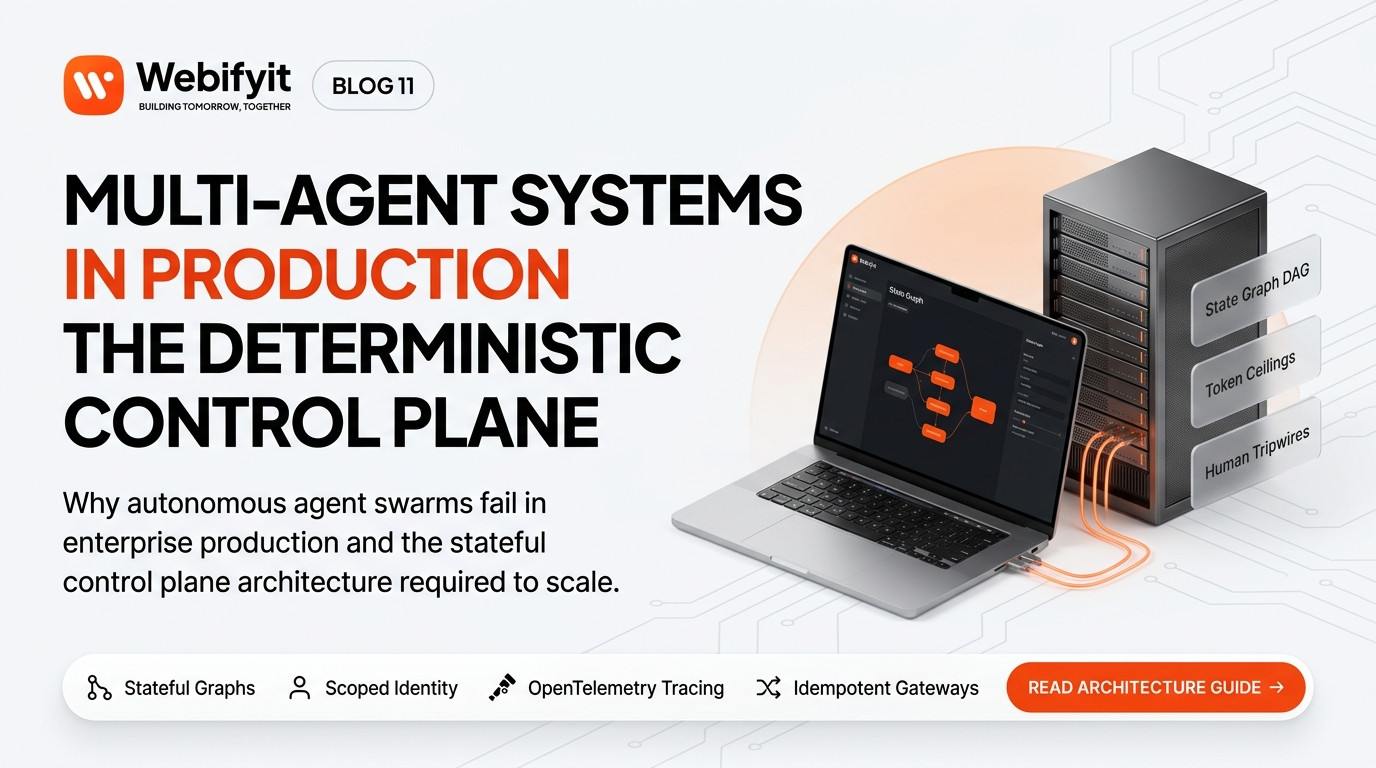
Multi-Agent Systems in Production: The Fallacy of "More Agents" and the Deterministic Control Plane Architecture for 2026
If you have followed artificial intelligence development over the past twelve months, you have witnessed the multi-agent explosion.
Every social media timeline is filled with demonstration scripts showing five, eight, or ten autonomous AI agents planning a company launch, drafting financial analyses, and reviewing code in a simulated digital boardroom.
Frameworks like CrewAI, AutoGen, and LangGraph made it deceptively simple to write a few lines of configuration declaring a Researcher Agent, a Writer Agent, a Critic Agent, and an Executive Agent, letting them chatter endlessly until a final report emerges.
In a controlled hackathon demo, the output looks magical.
Then engineering teams attempt to ship multi-agent systems to live enterprise production.
Within forty-eight hours of facing real enterprise workloads, messy customer inputs, and production traffic, the fantasy collapses:
- Hallucination compounding: If Agent 1 misinterprets an invoice date with an 8% margin of error, Agent 2 treats that hallucination as verified ground truth, and Agent 3 builds an entire financial model on fiction.
- Token budget explosions: Unbounded multi-agent discussions routinely burn through hundreds of thousands of tokens per single user request, turning a two-cent query into a four-dollar cloud infrastructure drain.
- Infinite reasoning loops: Two agents get locked into polite conversational stalemates, each asking the other to clarify requirements until execution timeouts sever the connection.
- The debugging nightmare: When an autonomous multi-agent pipeline corrupts a customer database record, nobody on the engineering team can explain which agent made the decision or why.
In 2026, enterprise software engineering has reached a mature consensus: free-form, conversational multi-agent systems are fundamentally unfit for production.
To build mission-critical enterprise AI that delivers real business value, engineering leaders are abandoning toy multi-agent setups in favor of Deterministic Control Plane Architectures.
In this architectural deep dive, we break down why multi-agent chains break, when multiple agents are genuinely necessary, and how enterprise engineering teams architect stateful, observable, and hardened control planes that scale.
The Multi-Agent Fallacy: Why "More Agents" Usually Means More Failure
The fundamental flaw behind early multi-agent adoption is the anthropomorphic assumption that software systems should mimic human corporate hierarchies.
Because human organizations assign work across research analysts, copywriters, and legal editors, developers assumed that AI software should instantiate separate language model personas talking to each other through conversational prompts.
This design pattern introduces severe structural liabilities:
1. Multiplicative Error Compounding
In traditional deterministic software, errors are additive. If one service fails, you capture the exception at the boundary.
In probabilistic multi-agent systems, errors are multiplicative. If Agent A operates at 92% semantic accuracy, Agent B at 90%, and Agent C at 91%, the cumulative pipeline reliability drops to approximately 75%.
One out of every four complex requests results in an unrecoverable failure or semantic corruption.
2. State Drift and Context Window Thrashing
When agents converse in natural language, they must pass their conversational transcripts back and forth.
Within three turns, 70% of the token context is consumed by polite conversational padding, redundant restatements of the problem, and fragmented intermediate thoughts.
This context pollution degrades reasoning performance, increases inference latency from sub-second responses to twenty-five seconds, and creates massive state drift where agents lose track of the original user objective.
3. The Lack of Bounded Authorization
If you deploy an autonomous Critic Agent with permission to modify database records based on its conversational evaluation, how do you enforce least-privilege security?
In conversational multi-agent setups, security is often left to prompt instructions. But natural language is not a security boundary. An injection exploit or ambiguous reasoning path can trigger unauthorized data modifications with zero audit trail.
The Golden Rule of Production AI in 2026:
Never use a multi-agent system when a single agent with well-defined tools can solve the problem.
The Architecture Hierarchy: Single Agent vs. Multi-Agent
Before allocating engineering resources to multi-agent infrastructure, evaluate where your business workflow actually sits on the operational complexity spectrum:
| Architecture Tier | Design Pattern | Typical Use Case | Production Reliability | Cost & Latency |
|---|---|---|---|---|
| Tier 1: Deterministic Pipeline | Traditional code with zero LLM orchestration | Data ETL, invoice parsing, arithmetic calculations | 99.99% | Microscopic cost, sub-100ms |
| Tier 2: Single Agent + Typed Tools | 1 reasoning agent equipped with schema-validated tools | Customer support triage, internal CRM lookup, lead qualification | High (94-98%) | Low cost, 1-3s latency |
| Tier 3: Router + Specialized Workers | Deterministic supervisor routing to isolated domain agents | Multi-department enterprise portals (HR vs IT vs Billing) | High (92-96%) | Moderate cost, isolated context |
| Tier 4: Stateful Graph Mesh | Graph-orchestrated multi-agent network with human checkpoints | Complex legal analysis, automated software migration, claims underwriting | High (90-95%) | Higher cost, controlled multi-step execution |
| Anti-Pattern: Conversational Multi-Agent | Autonomous personas chattering freely via prompts | Hacker news demos, toy brainstorming experiments | Unacceptable (<65%) | Extreme cost, runaway token burn |
For roughly 80% of enterprise business applications, Tier 2 (Single Agent + Typed Tools) delivers the highest accuracy, lowest latency, and easiest maintenance profile.
When Are Multiple Agents Genuinely Justified?
While conversational multi-agent setups are a trap, there are legitimate enterprise scenarios where an orchestrated multi-agent architecture is strictly necessary.
In production, multiple agents are justified only when one or more of these four architectural boundaries must be enforced:
1. Isolated Context Boundaries
Certain tasks require processing vast quantities of domain-specific data that would immediately overwhelm a single context window.
For example, an automated compliance review system might require auditing three hundred pages of financial transactions against five separate regulatory statutes.
Instantiating separate worker agents with dedicated, isolated context windows prevents token exhaustion and semantic confusion.
2. Heterogeneous Security and Authorization Scopes
In an enterprise environment, an AI system should never hold universal administrative credentials.
A public-facing triage agent must operate with zero database write permissions. A backend provisioning agent, meanwhile, requires access to cloud infrastructure APIs.
Decoupling these roles into distinct agents with isolated cryptographic credentials prevents privilege escalation even if the customer-facing agent encounters prompt injection.
3. Model Specialization and Cost Optimization
Different tasks require different foundation models.
Routing every simple intent classification through a massive frontier model is financially reckless. An optimized architecture uses a lightweight, sub-second model for initial request classification and sentiment detection, reserving the frontier reasoning model exclusively for deep structural analysis.
Coordinating these heterogeneous models requires an orchestrated agent hierarchy.
4. Asynchronous and Parallel Execution
When a business workflow involves multiple independent investigative tracks, running them sequentially creates unacceptable user latency.
An enterprise research control plane can dispatch three specialized agents simultaneously (one querying internal PostgreSQL records, one scanning Elasticsearch documents, and one verifying live external vendor APIs) before aggregating the results into a unified synthesis node.
The 5 Pillars of a Production Deterministic Control Plane
To move beyond fragile scripts and deploy multi-agent systems that survive enterprise scrutiny, engineering studios build around five core architectural pillars:
1. Explicit State Graphs (Replacing Free-Form Conversations)
Production architectures model multi-agent workflows as stateful, directed acyclic graphs (DAGs) rather than open-ended chat rooms.
Every node in the graph represents a discrete, deterministic step: an agent reasoning phase, a deterministic tool invocation, a data transformation, or a conditional routing check.
The global state is maintained in a centralized, immutable state object. When a worker agent completes its task, it does not speak to another agent; it emits a typed state update that is validated against a strict JSON Schema before the orchestrator transitions to the next node.
If an agent emits an invalid schema or fails its confidence threshold, the graph deterministically routes to an error-recovery node rather than spiraling out of control.
2. Strict Token and Iteration Ceilings
Production agents must never be allowed to loop indefinitely.
Every agent node must execute under hard engineering constraints:
- Maximum reasoning iterations per session (e.g., hard ceiling of 5 tool calls).
- Strict token budget caps enforced at the reverse proxy gateway.
- Wall-clock execution timeouts (e.g., 15 seconds maximum before triggering graceful degradation).
If an agent exhausts its iteration budget without resolving the task, the control plane immediately suspends execution, logs the incomplete state, and notifies a human operator.
3. Protocol-Level Human-in-the-Loop Tripwires
High-stakes business operations cannot be executed on probabilistic reasoning alone.
Production control planes implement deterministic gatekeeper tripwires:
- Read operations (querying customer history, summarizing documents) execute autonomously.
- Low-risk write operations (updating a support ticket status, adding an internal tag) execute with automated policy checks.
- High-risk business actions (issuing a financial refund, deleting customer records, modifying cloud infrastructure, or dispatching an outbound contractual email) trigger a mandatory protocol suspend.
The system stores the exact execution state, generates a human authorization ticket with full contextual reasoning, and dispatches an approval prompt to an operator via Slack, Microsoft Teams, or an internal dashboard.
The action only commits once an authorized human clicks Approve.
4. Distributed Tracing with OpenTelemetry
You cannot fix what you cannot measure.
Production multi-agent systems require full distributed tracing adhering to modern OpenTelemetry standards. Every user interaction generates a global trace identifier that follows the request across every subsystem:
- The exact user prompt and runtime system parameters.
- Token consumption, latency, and cache hit rates at every node.
- The intermediate reasoning steps and tool selection decisions.
- External API payloads, database queries, and response latencies.
When an anomaly occurs, engineering teams do not guess. They inspect the precise trace waterfall to pinpoint whether the issue stemmed from model hallucination, tool schema mismatch, or backend API latency.
5. Deterministic Tool Sandboxing and Idempotency
Agents must never interact directly with unshielded enterprise databases.
Every tool call executes inside a sandboxed gateway with:
- Mandatory Idempotency Keys: If a network blip causes an agent to retry a payment or ticket creation tool, the gateway recognizes the duplicate request and returns the existing result without double-execution.
- Read-Replica Routing: All exploratory agent queries run against read-only database replicas with strict memory and CPU caps.
- Parameter Whitelisting: Inputs are scrubbed and validated against strict schemas before touching internal microservices.
Practical Failure Modes and Engineering Fixes
| Production Failure Mode | Root Cause | Engineering Solution |
|---|---|---|
| Infinite Clarification Ping-Pong | Two agents prompt each other without termination criteria | Enforce maximum turn counters and hard state transitions on the graph orchestrator |
| Hallucination Cascades | Downstream agent accepts unverified upstream prose as factual truth | Require agents to emit structured JSON with confidence scores; validate outputs at graph boundaries |
| Budget Black Hole | High-volume traffic triggers recursive multi-agent reasoning chains | Implement token bucket rate-limiting and route simple intents to lightweight Tier 2 agents |
| Duplicate Side Effects | Agent retries a failed tool invocation after a transient network timeout | Mandate cryptographic idempotency keys on every state-altering tool gateway |
| Unexplainable Data Corruption | Conversational prompts grant broad administrative credentials | Decouple permissions into isolated worker roles with scoped, short-lived session tokens |
The Webifyit Approach: Building Accountable AI Systems
At Webifyit, we do not build fragile, toy AI prototypes that impress in a pitch meeting and shatter in production.
We approach artificial intelligence through the discipline of software engineering:
- Pragmatic Architecture: We start by analyzing your business problem. If a deterministic workflow or a single well-instrumented agent can solve it with 98% reliability, we will never sell you an over-engineered multi-agent maze.
- Deterministic Control Planes: When complex workflows require multi-agent orchestration, we architect state graphs with immutable state models, explicit error recovery, and robust human verification tripwires.
- Hardened Enterprise Gateways: We build the security boundaries, token budget limiters, and OpenTelemetry observability stacks required to satisfy corporate infosec and compliance teams.
- End-to-End Accountability: From architectural design to production deployment and monitoring, we deliver software that runs reliably day after day.
Action Checklist: Multi-Agent Production Readiness
Before greenlighting a multi-agent AI system for live users, verify your architecture against this checklist:
- Single-Agent Feasibility Test: Have you verified that this problem cannot be solved more reliably by a single agent with typed tools?
- Graph-Based Orchestration: Is the workflow governed by an explicit state graph rather than free-form conversational prompting?
- State Schema Validation: Are all intermediate agent outputs validated against typed schemas before transitioning to subsequent nodes?
- Hard Iteration & Token Ceilings: Are strict execution timeouts and token limits enforced at the reverse proxy gateway?
- Human-in-the-Loop Tripwires: Are all high-consequence, irreversible, or financial actions intercepted for human operator approval?
- Idempotent Tool Gateways: Do all state-modifying actions enforce unique transaction keys to prevent duplicate operations?
- End-to-End Observability: Is every node execution, tool call, and token expenditure tracked in an OpenTelemetry-compliant tracing system?
Frequently Asked Questions
Why are conversational multi-agent frameworks popular if they fail in production?
Conversational frameworks are fantastic for rapid ideation, research prototyping, and hackathons because they require minimal upfront structural code. However, production environments demand determinism, predictable latency, cost ceilings, and strict security—attributes that conversational prompting cannot provide.
How does LangGraph differ from conversational frameworks like CrewAI or AutoGen?
While CrewAI and AutoGen traditionally emphasize role-playing personas communicating through dialogue, LangGraph models workflows as cyclical state graphs. This gives engineering teams fine-grained control over state synchronization, conditional routing, checkpointing, and human approval gates, making it significantly better suited for production systems.
What is the typical latency of a production multi-agent system?
A well-architected graph with parallelized worker nodes typically completes within three to eight seconds. Conversely, unconstrained conversational multi-agent chains often take twenty to forty-five seconds due to redundant conversational turns and context thrashing.
Can multi-agent control planes integrate with Model Context Protocol (MCP)?
Yes. In fact, MCP is the ideal foundation for multi-agent architectures. In a modern control plane, specialized worker agents connect to standardized MCP servers to access enterprise resources and tools, completely decoupling agent reasoning from backend API implementations.
The Bottom Line
The future of enterprise AI does not belong to unconstrained swarms of conversational chatbots chattering without boundaries.
It belongs to deterministic, observable, and hardened control planes that combine the cognitive power of foundation models with the architectural rigor of enterprise software.
Build for reliability. Guard your state. Never let probabilistic models operate without deterministic guardrails.
Ready to design, build, or harden your enterprise AI agent architecture for live production?
Schedule an Architectural Consultation with Webifyit
Published by the Webifyit Engineering Team | Webifyit