
"How much will my app cost?"
It sounds like a simple question.
It isn't.
A founder might imagine a few screens, a login button and a database.
Then the requirements start:
"Can users pay?"
"Can they chat?"
"Can we send notifications?"
"What about iPhone and Android?"
"Can the admin manage everything?"
"Can we add Google Maps?"
"What about AI?"
"Can customers track orders in real time?"
And suddenly the "simple app" isn't so simple anymore.
That is why two companies can ask:
"How much does an app cost?"
and receive quotes of ₹1.5 lakh, ₹6 lakh and ₹20 lakh.
The developers aren't necessarily overcharging.
They may simply be estimating completely different products.
So instead of giving you one made-up number, let's break down what actually changes the cost.
Because the most important question isn't:
"How much does an app cost?"
It's:
"What exactly are we building?"
The quick answer
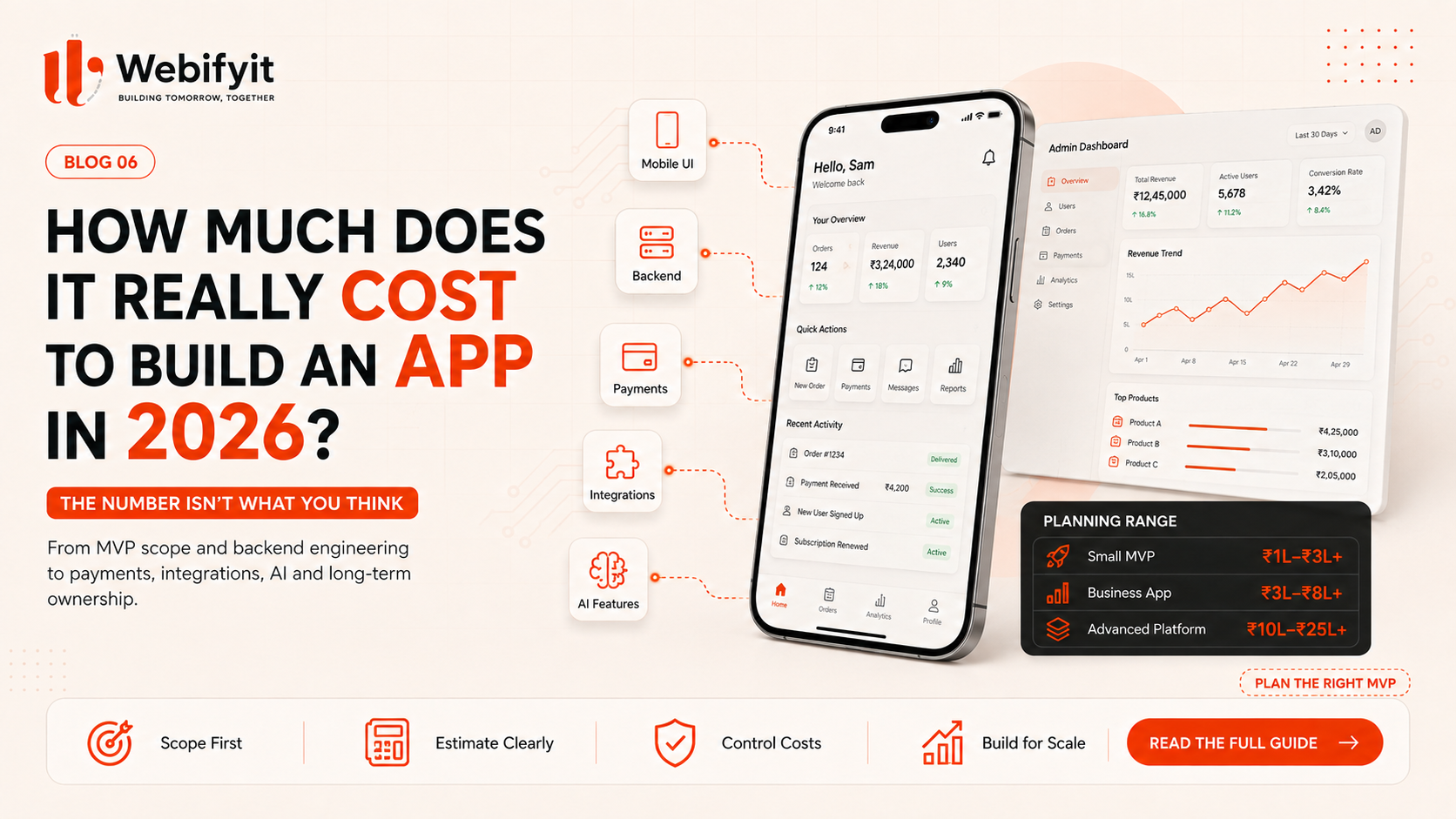
For rough planning in 2026, you can think about app projects in these broad ranges:
| App type | Typical planning range |
|---|---|
| Simple proof-of-concept | ₹40k–₹1L+ |
| Small MVP | ₹1L–₹3L+ |
| Standard business app | ₹3L–₹8L+ |
| Marketplace / advanced app | ₹6L–₹15L+ |
| Complex multi-role platform | ₹10L–₹25L+ |
| AI / real-time / highly integrated product | ₹15L–₹35L+ |
These are planning ranges, not fixed market prices.
The final cost depends on the product, team, technology, integrations, quality requirements and scope.
An app built for a startup in India can also have a very different budget from a production application being built for a US or UK business.
So don't use a pricing table as a quote.
Use it as a starting point.
A ₹1 lakh app and a ₹15 lakh app can both be called "mobile apps"
This is where many founders get confused.
Imagine App A:
Login
Profile
5 screens
Simple database
Basic notifications
That's relatively straightforward.
Now imagine App B:
Customer app
Provider app
Admin dashboard
Payments
Real-time tracking
Chat
Maps
Push notifications
Backend APIs
Role management
Analytics
AI
That's not just an app.
It's a software platform.
And the engineering effort should reflect that.
What actually drives app development cost?
If you remember one section from this article, make it this one.
1. Number of users and roles
This is one of the biggest cost drivers.
An application with one user type is relatively straightforward.
But consider:
Customer
Seller
Delivery partner
Admin
Each role may need:
different screens
different permissions
different workflows
different notifications
different APIs
different testing paths
So a "four-role app" isn't simply one app with four login buttons.
It can become several connected products sharing the same backend.
2. Number of screens
Screens matter, but they don't tell the whole story.
A simple app might have:
5–10 screens
A larger business application:
15–30 screens
A complex platform:
30–100+ screens
But don't make the mistake of pricing only by screen count.
A simple settings page isn't equivalent to:
real-time tracking
or
checkout
or
inventory management
or
AI interaction
The complexity behind the screen matters more than the number of screens.
3. Backend development
This is where many first-time founders underestimate a project.
The mobile interface is only one layer.
Behind it, you may need:
authentication
database
APIs
business logic
payments
notifications
file storage
analytics
admin controls
permissions
background jobs
logging
The backend can become a significant part of the project, especially when the application has complex workflows.
4. Admin panel
Founders often say:
"We just need an app."
Then development starts.
Someone asks:
"How will you manage users?"
"How will you edit products?"
"How will you handle refunds?"
"How will you see orders?"
"How will you change settings?"
"How will you manage content?"
Suddenly there is an admin panel.
And that can become a full application of its own.
For serious products, administration is often part of the product even though customers never see it.
5. Payments
Payments add another layer of complexity.
You may need:
payment gateway
payment states
success/failure handling
refunds
webhooks
transaction records
invoices
payment verification
security
And the right payment provider depends on where your business operates.
"Just add payments" can become considerably more engineering than it sounds.
6. Third-party integrations
Your app may need to connect with:
Google Maps
Stripe
Razorpay
Twilio
Firebase
HubSpot
Salesforce
Shopify
ERP systems
accounting software
AI APIs
One integration may be simple.
Another may require authentication, data mapping, custom logic, error handling and testing.
This is why two apps with similar interfaces can have completely different budgets.
7. Real-time functionality
Real-time features add another level of complexity.
Examples:
live tracking
chat
driver location
inventory availability
real-time order status
live dashboards
instant notifications
The backend has to continuously move information between systems and devices.
That means more engineering.
And more testing.
8. AI features
AI is another major variable.
Adding:
"Summarize this text."
can be relatively simple.
But:
"Understand the customer's request, search company data, check the CRM, take an action and escalate when necessary."
is a very different project.
AI features can involve:
model integration
prompt/workflow design
knowledge retrieval
tool calling
business rules
guardrails
evaluation
logging
monitoring
and ongoing API usage.
So don't ask only:
"Does the app have AI?"
Ask:
"What does the AI actually need to do?"
9. Design quality
There is a big difference between:
a functional app
and
a polished product experience.
Design can include:
wireframes
user flows
UI design
prototypes
design system
responsive layouts
animations
accessibility
usability testing
For consumer products especially, good UX isn't just decoration.
It affects whether people understand and actually use the product.
iOS + Android: one codebase or two?
Another question founders ask is:
"Do I need separate iOS and Android apps?"
Not necessarily.
You can build natively for each platform or use a cross-platform approach such as:
Flutter
React Native
The right choice depends on the product.
Cross-platform development can reduce duplicated work for many products, but platform-specific requirements may still require native implementation.
Don't choose a framework simply because it is popular.
Choose based on:
product requirements
performance
native functionality
team capability
maintenance
A simple app is not necessarily a simple business
This is an important distinction.
You can build a technically simple interface for a very complicated business.
For example, a booking app might look simple.
But behind it could be:
availability
pricing
allocation
cancellation
payments
notifications
identity verification
refunds
customer support
admin controls
The UI is only the visible layer.
The workflow underneath is where much of the complexity lives.
Look at the product, not just the app icon
When estimating cost, don't ask:
"How many screens will we have?"
Ask:
"What does the user need to accomplish?"
For example:
Discover
↓
Select
↓
Pay
↓
Receive
↓
Track
↓
Complete
That's the product workflow.
A better estimate starts by understanding that workflow.
What this looks like in real products
We've experienced this first-hand while building different products.
Dineezy
Dineezy is not simply a restaurant ordering app.
It connects multiple operational layers:
Customer ordering
↓
Restaurant
↓
Order management
↓
Kitchen workflow
↓
Delivery
↓
Rider application
↓
Business management
That requires considerably more engineering than a basic menu or ordering interface.
You can explore the product at:
HisabAI
HisabAI is a different type of product.
It is a finance and expense-management mobile product involving:
expense tracking
shared expenses
bill splitting
group balances
settlement workflows
and AI-assisted functionality.
The interface can look simple.
But the rules behind the product matter.
Who owes whom?
How is an expense divided?
What happens when an expense changes?
How are balances calculated?
Those are product rules.
And product rules require engineering.
Helpkey
Helpkey is another example.
It is a hospitality discovery and booking platform covering different types of stays, including:
hotels
homestays
villas
farmstays
and other properties.
The platform involves areas such as:
property discovery
customized booking experiences
room/accommodation allocation
identity verification
and other hospitality workflows.
The visible application is only one part of the product.
What does an MVP actually mean?
This word gets used far too often.
An MVP is not:
"Build the entire product cheaply."
It means:
"Build the smallest version that can test the most important assumption."
Those are very different ideas.
Imagine you're building a marketplace.
You probably don't need everything on day one.
You might start with:
customer signup
→
browse
→
select
→
book
→
pay
→
basic admin
That's enough to test whether people actually want the service.
Then you learn.
Then you build more.
The most expensive feature is sometimes the one nobody uses
This is a lesson worth remembering.
You can spend a lot of money building:
advanced analytics
social features
AI recommendations
complex loyalty
chat
20 filters
and discover later that users don't care.
That's why product validation matters.
The cost of software isn't only:
cost of development
It is also:
cost of building the wrong thing.
Why one developer says ₹1.5 lakh and another says ₹6 lakh
This doesn't automatically mean someone is overcharging.
Look at the assumptions behind each quote.
Maybe the first quote includes:
Android only
basic backend
no admin
limited integrations
while the second includes:
iOS + Android
custom backend
admin panel
payments
QA
deployment
analytics
support
Those are completely different projects.
Always compare the scope behind the number.
The cheapest quote isn't necessarily the cheapest product
Suppose:
Developer A quotes:
₹1.5 lakh
Developer B quotes:
₹6 lakh
It's tempting to immediately choose A.
But ask:
What is included?
How is the backend designed?
Is QA included?
Who handles deployment?
Are APIs included?
Are payments included?
Who owns the source code?
What happens after launch?
Who fixes bugs?
A cheap initial build can become expensive if the product has to be rebuilt later.
Total cost of ownership matters
Your budget shouldn't only contain the development invoice.
Think about:
development
hosting
third-party APIs
AI usage
SMS/OTP
maps
app-store costs
maintenance
support
monitoring
future development
The right question isn't:
"How much does it cost to build?"
It's:
"How much will it cost to own and operate?"
What about AI-assisted development?
AI coding tools can make developers faster.
They can help with:
boilerplate
UI components
tests
documentation
debugging
prototyping
refactoring
That's useful.
But:
Faster development does not mean finished software.
Production applications still need:
architecture
requirements
security
testing
integration
deployment
monitoring
maintenance
AI changes the economics of development.
It does not remove the need for engineering.
How to reduce app development cost without building a cheap product
You don't necessarily reduce the budget by hiring the cheapest developer.
Instead:
1. Reduce scope
Build only what is necessary to test the idea.
2. Integrate instead of rebuilding
Use mature services where they make sense.
3. Reuse proven components
Don't reinvent basic infrastructure unnecessarily.
4. Choose the right platform strategy
Use cross-platform development when appropriate.
5. Design before development
Fixing a workflow on paper is cheaper than changing it after coding.
6. Build one core workflow at a time
Don't spread your team across 30 features.
7. Avoid unnecessary complexity
Don't build for one million users before you have one thousand.
What should you build in version one?
Before starting development, ask:
What is the core problem?
Who is experiencing it?
What is the main action the user needs to complete?
What absolutely has to work?
What can wait?
What assumption are we trying to prove?
This gives your first version a job.
Without that, an MVP can quickly become a small version of a giant product that nobody has validated.
Before hiring a development team, prepare this
You don't need a 50-page technical document.
A good starting brief can include:
Problem
Target users
Main workflow
Must-have features
Nice-to-have features
Platforms
Integrations
Expected scale
Timeline
Business goal
That gives the development team enough context to give a more useful estimate.
Ask your developer this question
Instead of asking only:
"How much will this app cost?"
Ask:
"What assumptions are you making to arrive at that number?"
Then ask:
"What's excluded from the quote?"
These two questions can prevent a lot of surprises later.
What we believe at Webifyit
We don't believe every business needs a custom mobile application.
Sometimes:
buying SaaS is smarter.
Sometimes:
integrating existing software is smarter.
Sometimes:
a web application is enough.
Sometimes:
a mobile app is necessary.
And sometimes:
a smaller MVP is the right first step.
Our job is not to convince you to build more software.
Our job is to figure out what software you actually need.
Final takeaway
There is no universal price for building an app in 2026.
A small MVP can be relatively affordable.
A serious business application can cost several lakhs.
A complex marketplace, SaaS platform, AI application or multi-sided system can move into tens of lakhs or more.
The word:
"app"
doesn't tell you the cost.
What matters is:
users
workflows
business logic
backend
integrations
payments
security
AI
scale
and
what happens after launch.
So before asking:
"How much does an app cost?"
ask:
"What is the smallest version of this product that can prove the idea?"
That question can save you far more money than negotiating another ₹50,000 from a development quote.
Planning an app or MVP?
Webifyit helps founders and businesses turn an idea into a practical product plan, decide what should be built first, and choose the right mix of custom software, integrations, AI and mobile/web development.
Request a free project assessment →